
Knowing how to sell used aircraft parts legally comes down to truthful condition disclosure and verifiable traceability records. Civil aviation authorities allow anyone to sell removed hardware, provided you never misrepresent unserviceable items as airworthy and supply matching release tags, commercial trace forms, and life-limit histories required by installers.
Veteran traders often remark that aviation aftermarket sales are really paperwork transactions with metal attached. Two identical turbine bleed valves can command full rotable value with unbroken airline trace or drop to scrap alloy weight when a single form goes missing. Preparing complete, unaltered documentation protects your company from legal exposure and gets shipments past customer receiving inspection on the first check.
Key Takeaways
- Selling uncertified or As-Removed aviation hardware is legal when its exact condition and known defects are stated honestly.
- Installers carry return-to-service responsibility, while sellers face criminal and civil fraud penalties for altered or misleading records.
- Commercial buyers typically ask for an FAA Form 8130-3 or EASA Form 1, ATA Spec 106 trace, and an operator Non-Incident Statement.
- Life-Limited Parts require unbroken Back-to-Birth hour and cycle documentation from original manufacture to removal.
What Separates a Legal Sale from Parts Fraud?
Aviation law draws a sharp distinction between selling a component commercially and installing it on an aircraft. Under FAA 14 CFR Part 43 and EASA Part-145 rules—mirrored by Transport Canada, the UK CAA, and other national authorities—the certificated mechanic, repair station, and aircraft operator hold final legal responsibility for confirming airworthiness prior to installation. No regulation stops an aircraft owner, teardown company, or private individual from selling an uninspected component removed from a retired airframe.
Crossing into illegality happens the moment a seller falsifies records or misleads a buyer about origin, condition, or history. In the United States, 14 CFR 43.12 prohibits fraudulent or intentionally false maintenance entries, while federal statute 18 U.S.C. § 38 criminalizes fraud involving aircraft parts in interstate or foreign commerce. Attaching a photocopied release tag to the wrong serial number, hiding fire or flood exposure, or passing off counterfeit parts as genuine hardware brings criminal prosecution, civil fines, and industry debarment.
Core Traceability Packet: How to Sell Used Aircraft Parts to Commercial Buyers
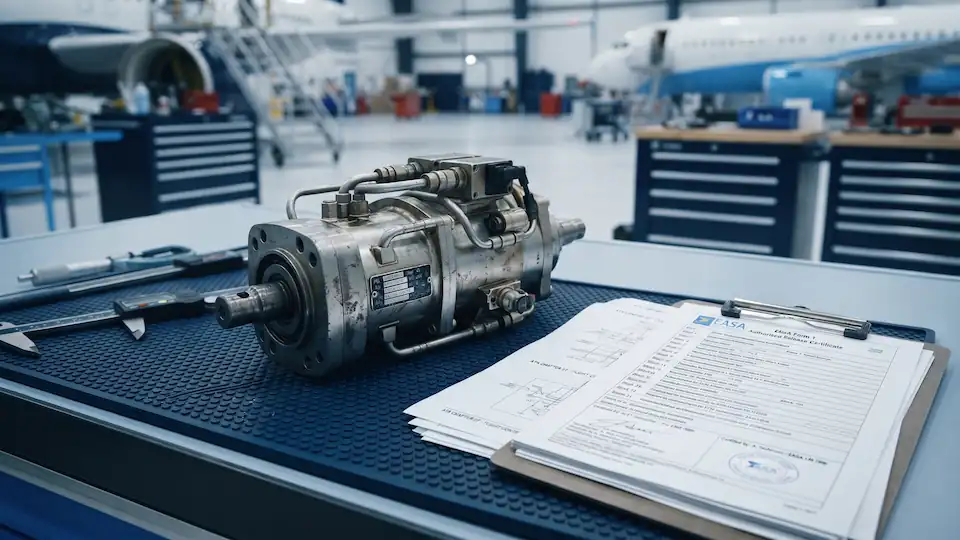
Commercial airlines, cargo carriers, and MROs enforce strict "no paperwork, no purchase" policies. Depending on which aircraft part conditions apply to your stock, procurement teams expect a complete document chain linking the part back to a regulated operator, repair station, or manufacturer. For Overhauled or Serviceable rotables, the centerpiece is valid FAA 8130-3 and EASA Form 1 certification—or a dual-release certificate accepted on both sides of the Atlantic. Reviewing a guide to FAA 8130-3 and EASA Form 1 certification before listing inventory ensures your serial numbers, modification status, and workscope remarks match the physical unit.
Behind the release certificate sits commercial custody paperwork. As an industry traceability practice, airlines and distributors use the ATA Spec 106 form (part of ATA Specification 106, Sources and Approved Parts Qualification Guidelines; the form itself is titled Part or Material Certification Form) to document each commercial transfer and confirm the item was stored without alteration. When selling As-Removed components harvested during teardown, you will not have a fresh shop release yet; instead, buyers ask for a donor removal tag (showing registration, airframe serial number, removal date, and reason for removal) paired with a Non-Incident Statement signed by the last certificated airline operator confirming the aircraft suffered no major accident, fire, or saltwater immersion. A Non-Incident Statement is a common industry and customer requirement rather than a statutory legal one, though commercial airlines and MROs routinely reject used rotables without it.
| Document | Typical Part Scope | Issued By | What It Proves |
|---|---|---|---|
| FAA 8130-3 / EASA Form 1 | Overhauled or Serviceable parts | Part 145 shop or PAH | Approved maintenance release to service |
| ATA Spec 106 Form | Commercial rotables and split lots | Selling airline or dealer | Chain of custody from regulated source |
| Removal Identification Tag | As-Removed teardown hardware | Operator or teardown facility | Donor tail number, date, removal reason |
| Non-Incident Statement | Commercial rotables and structures | Last certificated operator | Donor airframe had no severe accident |
| Back-to-Birth Package | Engine and gear Life-Limited Parts | OEM plus all past operators | Complete hours and cycles since new |
Back-to-Birth Traceability for Life-Limited Parts
Rotating turbine disks, spools, shafts, and primary landing gear pins carry mandatory fatigue retirement limits measured in flight hours or flight cycles. Unlike on-condition avionics boxes that can be tested and returned to service indefinitely, a Life-Limited Part must be permanently retired once it hits its published limit. Consequently, commercial buyers require complete Back-to-Birth traceability before paying rotable prices.
A compliant Back-to-Birth binder starts with the original manufacturer production release or engine delivery record establishing zero time. Every subsequent installation and removal across each aircraft registration and engine serial number must connect chronologically with zero unexplained calendar or hour gaps, supported by operator utilization summaries and shop visit records. If even one intermediate operator statement is missing, airlines cannot verify remaining fatigue life, reducing an expensive titanium disk to scrap metal value.
General Aviation Sales vs Commercial Airline Requirements
Documentation expectations look noticeably different when parting out light piston aircraft operated privately under FAA Part 91 or equivalent general aviation rules abroad. A private owner buying a used alternator, control surface, or cylinder assembly for a light single-engine airplane does not always legally need an FAA Form 8130-3. Instead, a certificated Airframe and Powerplant mechanic can inspect the used part, check applicable Airworthiness Directives, verify conformity, and record the installation directly in the aircraft maintenance logbooks .
Even in general aviation markets, complete records unlock much stronger resale prices. Providing copies of donor logbook entries, total airframe hours at removal, and a clear bill of sale reassures mechanics that the part did not come from an unrecorded wreck. Sellers scaling from occasional hangar cleanouts into commercial inventory trading should formalize receiving checks by routing uncertified cores through a certificated Part 145 repair station and following best practices for setting up an aircraft parts dealership.
Handling Unserviceable Cores, Scrap, and Suspected Unapproved Parts
Before listing any used component, inspect the physical data plate under magnification. Missing rivets, over-stamped digits, mismatched dash numbers, or altered serial plates are classic warning signs of Suspected Unapproved Parts. Quarantine questionable items immediately rather than returning them to open circulation, and report confirmed unapproved or counterfeit discoveries through official aviation authority reporting channels.
Hardware condemned as Beyond Economical Repair, fire-damaged, or zero-life-remaining should never be sold intact without strict scrap controls. Following FAA and EASA scrap disposal guidance, responsible sellers physically mutilate unsalvageable parts—by torch-cutting, grinding critical mounting flanges, or drilling through bearing journals—before recycling the alloy so scrap components can never be cleaned, repainted, and fraudulently sold as flight hardware.
Frequently Asked Questions
Can you legally sell As-Removed aircraft parts without an 8130-3 tag?
Yes. Selling As-Removed hardware online or directly to brokers and repair shops is legal when you accurately state its uncertified condition and disclose any known defects. Never advertise an untagged component as airworthy or ready to install, and attach the donor aircraft removal tag whenever available to preserve value.
Who is allowed to sign an aviation Non-Incident Statement?
Airlines, lessors, and Part 145 repair stations require the Non-Incident Statement to be issued on official letterhead by an authorized quality or engineering representative of the last certificated aircraft operator, . Self-authored incident letters written by third-party brokers are often rejected during receiving inspection.
Does an ATA Spec 106 form certify that a part is airworthy?
No. An ATA Spec 106 form is a commercial material traceability document showing who sold the part, where it originated, and that it was stored without alteration. It never replaces maintenance or production approval; buyers still require the underlying FAA Form 8130-3, EASA Form 1, or manufacturer conformity certificate.