Commonly used aircraft part conditions, listed on trading platforms as FN, NE, NS, OH, SV, and AR, describe a component's maintenance history, airworthiness status, and required documentation. Because definitions vary by vendor, buyers must confirm each code's exact meaning with the seller to avoid ordering uncertified hardware that delays maintenance or violates lease agreements.
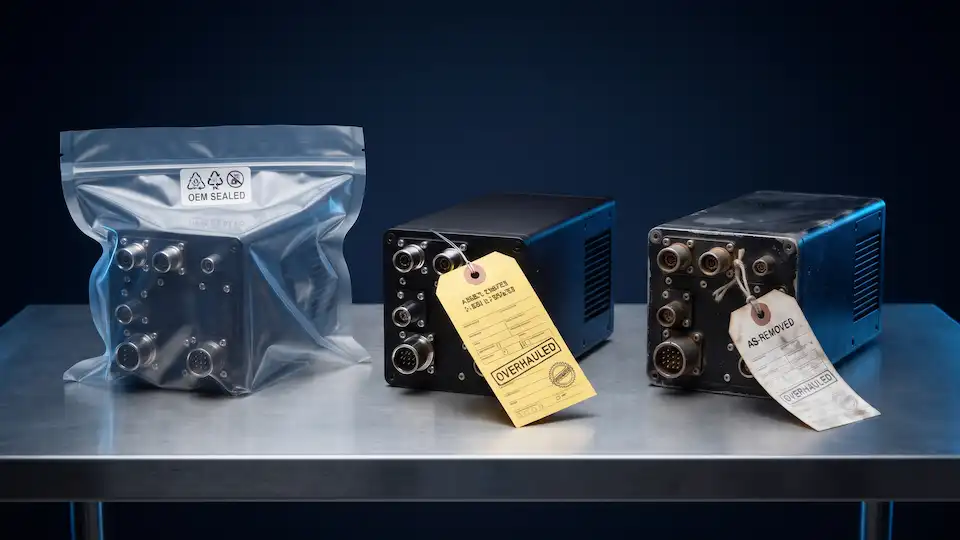
When procurement teams evaluate quotes on electronic marketplaces, identical part numbers often vary widely in price because one vendor offers an untested As-Removed core while another quotes a freshly Overhauled unit carrying dual-release paperwork. Matching the right condition code to your operational timeline and lease contract keeps maintenance costs under control without compromising compliance.
Key Takeaways
- Factory New (FN), New (NE), and New Surplus (NS) all have zero flight hours, yet differ in manufacturer custody, warranty transfer, and storage age.
- Overhauled (OH) resets Time Since Overhaul to zero after full manual disassembly, while Serviceable (SV) covers repaired or bench-tested units.
- As-Removed (AR) components cannot be installed on commercial aircraft until a rated repair station inspects and releases them.
- Aircraft lease redelivery clauses frequently dictate whether operators must install fresh OH hardware instead of SV units.
Comparing Common Aircraft Part Conditions at a Glance
Global B2B marketplaces and airline ERP platforms rely on commonly used two-letter shorthand to categorize inventory, but exact definitions vary by vendor and platform, so buyers must always confirm condition details directly with the seller. While commercial codes speed up quoting, civil aviation authorities such as the FAA and EASA evaluate installation eligibility based on the actual maintenance or production release certificate attached to the box rather than the marketplace abbreviation alone. Transport Canada, the UK CAA, and other regulators apply similar scrutiny to underlying release remarks.
Before issuing a purchase order, buyers must confirm both the marketplace condition code and the exact workscope written on the release tag. A vendor listing a component as Serviceable could be offering a unit that passed a quick functional bench check yesterday or one repaired five years ago that has sat in unmonitored storage ever since.
| Code | Full Name | Ready to Install | Typical Paperwork | Time Since Overhaul |
|---|---|---|---|---|
| FN | Factory New | Yes | OEM C of C or Production Tag | Zero hours / cycles |
| NE | New | Yes | OEM C of C plus Dealer Trace | Zero hours / cycles |
| NS | New Surplus | Check shelf life | Original OEM Trace plus ATA 106 | Zero operating time |
| OH | Overhauled | Yes | Maintenance 8130-3 / Form 1 (OH) | Reset to zero |
| SV | Serviceable | Yes | Maintenance 8130-3 / Form 1 (RP/IN) | Retains prior TSO |
| AR | As-Removed | No (Needs shop test) | Removal Tag plus Operator NIS | Unverified as-is |
| BER | Beyond Economical Repair | No (Scrap or core) | Shop Rejection or Scrap Tag | Not applicable |
Factory New (FN), New (NE), and New Surplus (NS): Why Unused Parts Differ
To someone outside aviation, an unused part in sealed packaging is simply new. In aerospace procurement, custody history separates unused inventory into three distinct tiers. Factory New (FN) hardware ships directly from the Original Equipment Manufacturer, Production Approval Holder—including approved PMA parts producers—or an officially franchised distributor. FN units carry current manufacturing dates, unbroken factory provenance, and full manufacturer warranty backing.
New (NE) describes unused, zero-time parts traded through independent accredited distributors with complete OEM traceability, though the original manufacturer may not transfer factory warranty outside its authorized network, leaving the selling dealer to provide commercial warranty coverage. New Surplus (NS) refers to unused excess inventory originally purchased by an airline or MRO for fleet provisioning and later sold onto the aftermarket, making it a common middle ground when comparing OEM vs PMA vs surplus parts. Buyers researching where to buy parts online often find NS listings at substantial discounts below factory list, yet they must check cure dates and calendar shelf life: internal rubber seals inside a hydraulic valve stored for eight years often require fresh bench testing and seal replacement before installation.
Overhauled (OH) vs Serviceable (SV): Choosing Used Airworthy Rotables
High-value rotable assemblies—such as starter-generators, flight control actuators, and avionics line-replaceable units—are engineered to cycle through repair shops repeatedly over an airliner's service life. Under FAA 14 CFR 43.2, a component may only be certified as Overhauled (OH) after being disassembled, cleaned, inspected, repaired as needed, reassembled, and tested in accordance with approved Component Maintenance Manual engine overhaul tolerances. An overhaul resets Time Since Overhaul (TSO) to zero and commands higher pricing plus stronger shop warranty terms.
Serviceable (SV) is the broader commercial category for used airworthy components approved for installation without undergoing a complete overhaul teardown. When you check FAA 8130-3 and EASA Form 1 certification details using a guide to reading an airworthiness release tag, SV units typically show either Inspected/Tested (passed functional bench testing with no internal fault) or Repaired (a targeted defect was fixed and tested) by a certificated Part 145 repair station. Understanding how airlines buy and lease aircraft explains when each code makes sense: SV units trim maintenance spend on mature fleets, whereas lease return contracts often mandate fresh OH status on hard-time assemblies.
What Does As-Removed (AR) Mean for Buyers and Core Exchanges?
An As-Removed (AR) component came directly off an aircraft—during scheduled part-out teardown, modification upgrades, or line troubleshooting—and has not visited a repair station since removal. Commercial operators cannot bolt an AR unit onto an aircraft. Despite that restriction, AR hardware accounts for massive daily trading volume across global aftermarket platforms.
Two business needs drive AR demand. First, airlines buying an Overhauled unit on an exchange basis owe the supplier a rebuildable core; if the airline's removed unit suffered housing damage, buying an AR core on the open market avoids steep exchange penalties that heavily influence how aircraft parts are priced. Second, stocking dealers buy clean AR units backed by required documents to sell used aircraft parts, send them to Part 145 shops for bench testing, and resell them as certified SV stock. Always ask why an AR part was pulled: teardown harvests pass bench tests far more reliably than troubleshooting removals.
Beyond Economical Repair (BER) and Buyer Inspection Traps
When a repair station inducts an AR core and discovers cracked castings, obsolete circuit boards, or repair labor plus piece-part costs exceeding the market value of a ready-to-install SV replacement, the shop declares the unit Beyond Economical Repair (BER). BER units hold value only for non-critical piece-part harvesting under repair station supervision or scrap recovery.
Smart buyers protect themselves against condition traps before wiring funds by requesting high-resolution photos of the physical data plate alongside front-and-back scans of all tags. Check the date on OH and SV release certificates as well: depending on internal quality policies and storage conditions, some operators require a fresh preservation inspection or bench test before installing a component with an older shop release tag.
Frequently Asked Questions
Can an As-Removed (AR) part be installed directly on a commercial aircraft?
No. Commercial airlines operating under FAA Part 121 or Part 135, as well as EASA operators, cannot install an As-Removed component directly onto an aircraft. An appropriately rated Part 145 repair station must first inspect, bench test, repair, or overhaul the unit and issue an authorized airworthiness release tag.
Does an overhaul reset Total Time Since New on Life-Limited Parts?
Never. Overhauling an assembly resets only Time Since Overhaul (TSO) to zero after restoring dimensional and functional tolerances. Total Time Since New (TSN) and Cycles Since New (CSN) continue accumulating permanently on Life-Limited Parts, which must be retired and mutilated once they reach the manufacturer's mandatory fatigue limit.
Why is New Surplus cheaper than Factory New if both have zero hours?
New Surplus hardware sits outside the manufacturer's authorized distribution channel after an airline or MRO liquidates excess stock, meaning the original factory warranty rarely transfers to the new buyer. Older cure dates on internal rubber seals may also require a fresh shop bench test before an airline installs the unit.