
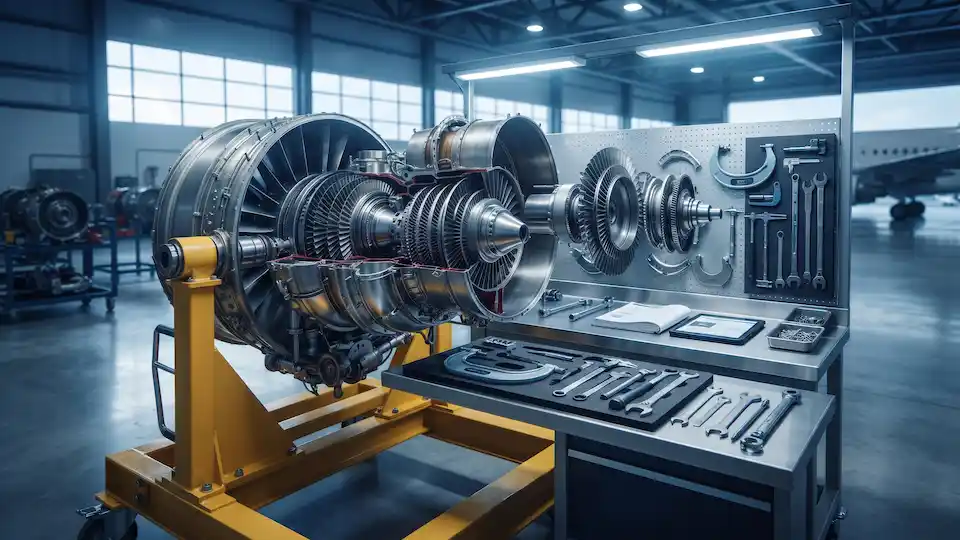
When an aircraft powerplant experiences internal mechanical wear or approaches its recommended operating life, operators face an important technical and financial decision: whether to select an engine overhaul, authorize a targeted repair, or proceed with an engine replacement. Evaluating these choices requires balancing shop turnaround times, core exchange terms, warranty protection, and long-term asset value.
Selecting an unsuitable maintenance scope can result in prolonged aircraft downtime or repair expenses that rival the residual value of the airframe. Understanding how engine maintenance facilities structure workscopes and cost estimates enables owners and flight department managers to make informed, cost-effective decisions.
Key Takeaways
- An engine repair addresses localized defects (such as a single cylinder replacement or accessory repair) without requiring complete engine disassembly.
- An overhaul disassembles, cleans, inspects, machines, and rebuilds the powerplant to manufacturer service limits.
- An overhaul resets Time Since Overhaul (TSO) to zero, but Time Since New (TSN) and Cycles Since New (CSN) are permanent and never reset.
- An engine replacement swaps the removed powerplant for an overhauled or factory remanufactured core, minimizing hangar downtime.
Defining Powerplant Maintenance Scopes
Aviation powerplant maintenance generally encompasses three distinct operational approaches. A repair corrects an isolated mechanical discrepancy—such as replacing an unserviceable cylinder assembly (often termed a top overhaul), servicing an exhaust valve, or exchanging a failed fuel servo—without disassembling the crankcase or disturbing the main bearings and crankshaft.
An overhaul (defined under FAA 14 CFR 43.2 and executed according to manufacturer overhaul manuals) requires removing the engine from the airframe, completely disassembling the case, performing non-destructive testing on critical rotating parts, replacing mandatory replacement hardware, and rebuilding the engine to serviceable or new tolerances before testing. For general aviation operators flying under 14 CFR Part 91, manufacturer Time Between Overhaul (TBO) recommendations generally serve as advisory guidance rather than hard operational mandates, provided the engine continues to pass periodic inspections and compression checks. Conversely, commercial operations under Part 135 or Part 121 are typically bound to mandatory overhaul intervals or FAA-approved progressive maintenance programs.
A replacement involves removing the engine and installing a freshly overhauled or factory-remanufactured unit obtained outright or on an exchange basis, allowing the aircraft to return to service without waiting for teardown queues.
| Maintenance Option | Typical Hangar Downtime | Scope of Work | Warranty Coverage | Typical Application |
|---|---|---|---|---|
| Targeted Repair | Several days to 2 weeks | Localized component repair or replacement | Limited to specific parts serviced | Isolated defect with low total time |
| Complete Overhaul | Several weeks to months | Full disassembly, inspection, machining, rebuild | Often 1 to 2 years (frequently prorated) | High operating hours, sound core engine |
| Replacement (Exchange) | Typically 3 to 7 days after delivery | Direct exchange with overhauled powerplant core | Supplier overhaul warranty terms | Urgent operational schedule demands |
| Factory Remanufactured | Rapid swap once core arrives | Rebuilt to factory-new tolerances by OEM | Comprehensive manufacturer warranty | Long-term asset value enhancement |
Cost Drivers, Core Charges, and Shop Turnaround Times
Powerplant maintenance quotations depend on workscope definitions and component condition upon teardown. An initial overhaul estimate typically covers basic disassembly labor, non-destructive testing, and standard overhaul kits (including seals, gaskets, bearings, and fasteners). However, once the repair station opens the engine cases, discovered discrepancies—such as cracked crankcase castings, worn camshaft lobes, or out-of-tolerance connecting rods—add supplementary machining and parts costs.
During teardown, certified technicians also audit compliance with mandatory airworthiness directives vs manufacturer service bulletins, confirming that all applicable AD terminating actions on crankshafts, crankcases, and accessories are incorporated. Specialized Part 145 repair station facilities holding appropriate powerplant ratings utilize precision balancing machinery and test cells to verify engine parameters prior to return-to-service sign-off.
When evaluating alternative used powerplants or exchange cores, our technical guide on how to buy a used aircraft engine outlines the vital steps for auditing historical logbooks, remaining life on life-limited parts, and borescope inspection records.
Decision Framework: Repair, Overhaul, or Replace
Selecting between repairing, overhauling, or replacing a powerplant involves weighing capital costs against downtime requirements. If an engine has accumulated high total hours and displays widespread internal wear or increased oil consumption, piecemeal repairs often prove uneconomical over time compared to a full overhaul or replacement.
Conversely, if a relatively low-time engine experiences low compression on an individual cylinder due to a localized valve defect, a targeted repair can resolve the issue efficiently. When evaluating used aircraft, referencing our used aircraft acquisition guide assists in reviewing past engine logs to verify whether prior owners adhered to scheduled maintenance practices or relied on temporary fixes.
Common Maintenance Budgeting Considerations
Operators frequently encounter three unexpected cost factors during engine maintenance projects. First, failing to establish clear pre-authorization limits with the overhaul facility before teardown can lead to unapproved replacements of high-value parts. Establishing clear communication protocols ensures the owner reviews major component replacements before work proceeds.
Second, freight expenses, protective crating, and engine crane rentals add noticeable logistics costs when transporting heavy powerplants to distant overhaul centers. Third, core exchange penalties can arise if the removed engine has unserviceable crankcases, unapproved welded repairs, or missing external accessories.
Frequently Asked Questions
What is the difference between an engine overhaul and remanufacturing?
An overhaul is completed by an authorized repair station that inspects and restores a used engine to service limits using approved data, resetting Time Since Overhaul (TSO) to zero. A factory remanufactured engine is rebuilt exclusively by the original production certificate holder using specialized tooling and zero-timed components to factory-new tolerances under 14 CFR 91.421; however, total time on life-limited components and permanent airframe history remain documented.
How long does an aircraft engine overhaul typically take?
Turnaround times vary widely depending on facility backlog, parts supply chain lead times, and whether specialized sub-contracted machining is required, frequently ranging from several weeks to a few months.
What is a top overhaul on an aircraft piston engine?
A top overhaul involves inspecting, repairing, or replacing the assemblies attached to the top end of the engine—including cylinders, pistons, rings, valves, and spark plug bosses—without splitting the crankcase or disturbing the crankshaft and main bearings.