
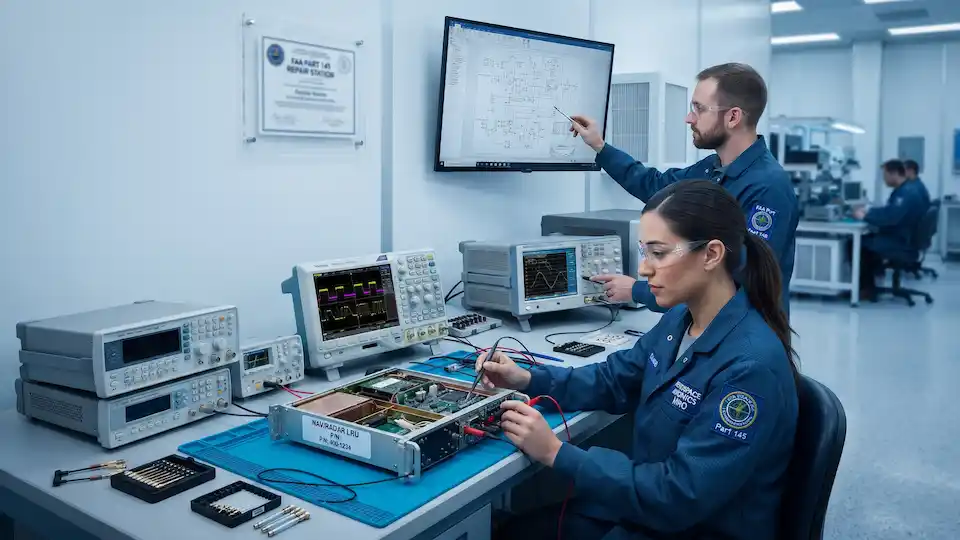
A Part 145 repair station is a maintenance facility certificated by the FAA under 14 CFR Part 145—or by EASA under Part-145—to perform specialized maintenance, alterations, and overhauls on aircraft, engines, propellers, and components. Unlike independent A&P mechanics working out of a general hangar, Part 145 repair stations operate under an approved Repair Station Manual, maintain strict quality control systems, and possess specific ratings to issue authorized maintenance release tags.
Choosing the right repair station directly impacts maintenance turnaround times, warranty coverage, and component resale values. Whether you are routing an As-Removed rotable for overhaul or scheduling a heavy airframe check, selecting an appropriately rated facility protects your maintenance budget and regulatory compliance.
Key Takeaways
- FAA Part 145 and EASA Part-145 repair stations are certificated maintenance organizations operating under approved quality manuals.
- Repair stations hold specific ratings (such as Airframe, Powerplant, Radio, Instrument, or Accessory) limiting the work they can legally perform.
- Only certificated repair stations and authorized air agency personnel can sign maintenance release documents like FAA Form 8130-3 or EASA Form 1.
- Choosing an MRO requires auditing rating capability lists, technician training records, calibration standards, and turnaround time histories.
Understanding Part 145 Repair Station Ratings and Capabilities
A repair station cannot legally work on every aircraft system simply because it holds a certificate. Under regulatory frameworks, every repair station is issued a Repair Station Certificate paired with a formal Operations Specifications (OpSpecs) document that defines its exact ratings:
- Airframe Ratings: Ranging from Class 1 composite light aircraft up to Class 4 large multi-engine transport category jet airframes.
- Powerplant Ratings: Authorized for reciprocating or turbine engine overhaul, testing, and hot-section repairs.
- Radio, Instrument, and Accessory Ratings: Specialized shops equipped with calibrated test benches to overhaul avionics, gyros, generators, and pneumatic valves.
- Limited Ratings: Specialized authorizations for specific components, non-destructive testing (NDT), or specialized welding without holding a broad class rating.
Before sending components or aircraft to an MRO, verify that their OpSpecs cover your exact part number or airframe model. Entrusting a complex digital flight display to a shop holding only mechanical accessory ratings violates maintenance rules and yields invalid release paperwork.
| Rating Class | Typical Facility Scope | Primary Regulated Equipment | Authorized Return-to-Service |
|---|---|---|---|
| Airframe Class 3/4 | Heavy MRO hangars | Transport category jet airframes | Airframe structural & systems release |
| Powerplant Class 1/2/3 | Engine overhaul shops | Reciprocating and turbine engines | Engine logbook or 8130-3 dual release |
| Radio / Avionics | Bench-test labs | Navigation, comms, radar LRUs | Component 8130-3 / Form 1 release |
| Accessory Class 1-3 | Pneumatic & hydraulic shops | Actuators, generators, pumps | Component 8130-3 / Form 1 release |
| Limited Rating | Specialized NDT / Plating | Specialized processes or parts | Authorized workscope sign-off |
Why Part 145 Certification Matters for Parts and Maintenance
Independent mechanics and small hangars can perform minor maintenance under basic A&P privileges, but complex overhauls and many customer-required releases need Part 145 infrastructure. Part 145 facilities must maintain a formal Quality Control System, calibrated tooling traceable to national standards, documented technician training programs, and independent inspection segregation.
When an uncertified As-Removed component is sent to a Part 145 shop for testing, the facility exercises its maintenance authority to overhaul or repair the unit, conduct functional testing, and issue valid FAA 8130-3 and EASA Form 1 certification. Without that shop release, used rotable parts cannot be installed on commercial transport aircraft. Understanding these shop workflows also helps operators navigate decisions when comparing engine overhaul vs repair vs replacement.
Five-Step Checklist for Choosing a Repair Station
Selecting the right MRO partner prevents costly project delays and quality disputes. Follow these five steps when vetting a new repair station:
- Verify Certificate and OpSpecs: Request a copy of their FAA or EASA certificate and verify their ratings, limitations, and geographic authorization online or through agency databases.
- Audit Quality Manual and Turnaround History: Review their Repair Station Manual and ask for average turnaround time (TAT) guarantees on your specific component type.
- Inspect Tool Calibration and Traceability: Confirm that all precision test stands, multimeters, and torque wrenches carry active calibration stickers traceable to NIST or international standards.
- Evaluate Warranty and Core Policies: Clarify shop warranty coverage periods and review their policy on handling unexpected sub-component scrap found during teardown.
- Check AD and SB Compliance Capability: Ensure the facility routinely incorporates applicable airworthiness directives vs service bulletins during component overhauls.
Common Pitfalls When Outsourcing Maintenance
Three recurring traps catch operators and brokers off guard. First, assuming a shop with an airframe rating can automatically overhaul specialized accessories; if a component falls outside their limited OpSpec ratings, their sign-off is illegal. Second, failing to establish fixed-price caps or scrap-approval thresholds prior to engine or rotable teardown, leading to surprise invoices when minor repairs escalate into major overhauls.
Third, neglecting to verify whether the shop holds dual FAA and EASA ratings when maintaining parts destined for European-registered aircraft, requiring costly re-inspection at another facility.
Frequently Asked Questions
What is the difference between an A&P mechanic and a Part 145 repair station?
An A&P (Airframe and Powerplant) mechanic is an individually certificated airman authorized to perform and approve certain maintenance under 14 CFR Part 43. A Part 145 repair station is a business organization holding an air agency certificate with defined ratings, operating under an approved quality manual and management structure to handle complex overhauls and component releases.
Can a repair station issue an FAA Form 8130-3 for any aircraft part?
No. A repair station can only issue an authorized airworthiness release tag for components and ratings explicitly listed on its approved Operations Specifications (OpSpecs). Issuing tags outside their certificated rating scope violates federal maintenance regulations.
What is a Repair Station Manual (RSM)?
A Repair Station Manual is the primary governing document required by FAA and EASA regulations that outlines a Part 145 facility's organizational structure, inspection systems, quality control procedures, and technician training protocols.