
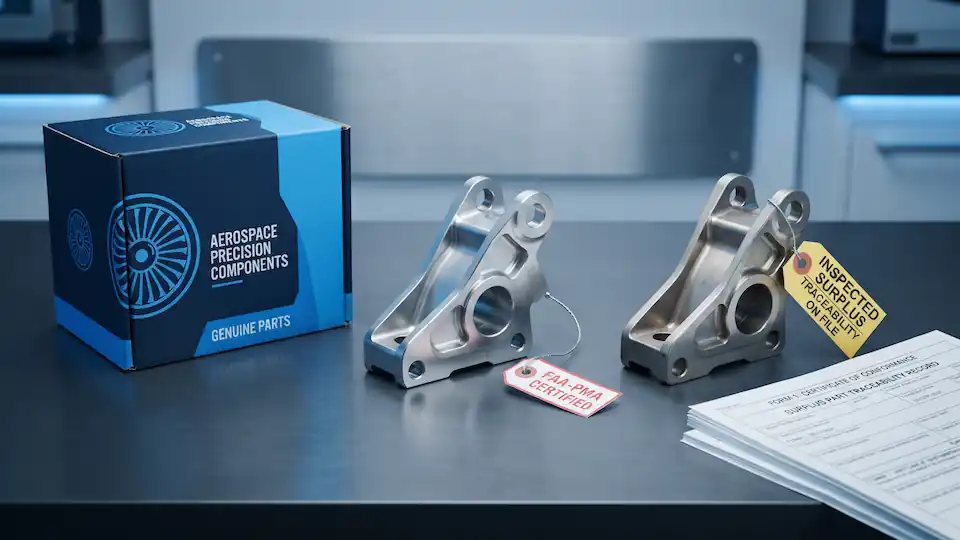
Choosing between OEM vs PMA vs surplus parts depends on regulatory eligibility, aircraft lease clauses, lead time, and total maintenance budget. OEM parts come from the original design or production holder, PMA parts are FAA-approved aftermarket replacements built by independent manufacturers, and surplus parts are genuine excess OEM or operator stock resold outside factory channels.
Buyers new to aviation procurement often treat these three categories as interchangeable ways to source the same part number. In practice, ordering an aftermarket replacement or a surplus lot without checking national registry rules and lease redelivery terms can leave an expensive component stuck in receiving quarantine while an aircraft waits on the ramp.
Key Takeaways
- OEM articles are produced under a Type Certificate or Production Certificate and carry full factory support when bought through authorized channels.
- FAA-approved PMA parts offer legal, engineered alternatives to factory monopolies, though foreign registries and aircraft leases can restrict their use.
- Surplus describes a supply-chain source rather than a manufacturer, covering unused airline excess stock as well as used recertified rotables.
- Always verify lease covenants, bilateral registry acceptance, cure dates, and release tags before issuing a purchase order.
What Separates OEM, PMA, and Surplus Parts Under Aviation Rules?
An Original Equipment Manufacturer (OEM) part is produced under the approved quality system of a Production Approval Holder—such as an airframe, engine, or appliance Type Certificate or Technical Standard Order holder—under FAA 14 CFR Part 21 or EASA Part 21. One compliance trap catches industrial buyers off guard: a sub-tier machine shop making brackets for an engine manufacturer cannot legally sell extra runs directly to airlines unless it holds written direct-ship authority from that Production Approval Holder.
By contrast, PMA parts are replacement or modification articles built under an independent FAA Parts Manufacturer Approval (14 CFR Part 21 Subpart K). Manufacturers earn approval via an OEM licensing agreement, through test and computation engineering proving equivalent or superior airworthiness, or alongside a Supplemental Type Certificate modification. Surplus parts are not a third manufacturing category; instead, surplus stock consists of previously purchased OEM—or occasionally PMA—hardware liquidated by airlines, MROs, or teardowns across different aircraft part conditions.
OEM vs PMA vs Surplus Parts: Side-by-Side Comparison
Price, availability, and warranty behavior diverge sharply across these three options. Authorized factory channels deliver guaranteed latest-revision engineering and manufacturer warranty backing, yet sole-source OEM pricing and long production queues often strain maintenance budgets. Healthy competition between approved aftermarket producers and airline surplus sellers directly shapes how aircraft parts are priced on high-burn expendables and mature airframe rotables.
Traceability packages differ just as clearly. Factory shipments arrive with manufacturer Certificates of Conformance or production release tags, PMA hardware carries permanent "FAA-PMA" markings plus an installation eligibility supplement, and commercial surplus rotables rely on custody paperwork backed by FAA 8130-3 and EASA Form 1 certification when sold ready to install.
| Criteria | OEM (Factory) | PMA (Aftermarket) | New Surplus (NS) | Used Surplus (OH/SV) |
|---|---|---|---|---|
| Original Producer | TC / PC / TSO holder | FAA Part 21K holder | Usually OEM (excess) | Usually OEM (used) |
| Operating Hours | Zero time | Zero time | Zero time | Prior flight time |
| Warranty Source | Manufacturer | PMA holder | Selling dealer only | Repair station / dealer |
| Lease Acceptance | Generally accepted | Often restricted | Check shelf-life rules | Check TSO / tag rules |
| Typical Lead Time | Immediate to months | Usually stocked fast | Immediate stock | Immediate stock |
How Do FAA, EASA, and Lessors Treat PMA Installations?
Inside the United States, FAA-approved PMA articles are fully airworthy replacements on every type-certificated model listed on the PMA supplement. International operations require closer verification. Under US-EU bilateral rules, EASA generally accepts non-critical FAA-PMA components and licensing-agreement PMAs when appropriate bilateral statements appear on the release tag, whereas critical PMA parts typically require separate EASA approval such as an EASA STC . Other national authorities apply their own validation rules, so operators must check State of Registry requirements first.
Commercial contracts frequently impose tighter barriers than aviation regulators. Understanding how airlines buy and lease aircraft explains why engineering teams check legal binders before approving aftermarket alternates: many operating leases and engine maintenance programs prohibit non-OEM parts or require stripping them out prior to lease return. Upfront purchase savings disappear fast if your airline must pay shop labor to reinstall OEM parts before redelivery.
Evaluating Surplus Inventory Without Falling Into Traceability Traps
Surplus hardware splits into New Surplus (unused excess airline or MRO provisioning stock) and Used Surplus (overhauled, serviceable, or as-removed components from retired fleets). New Surplus offers zero-time OEM hardware below catalog list, though factory warranties seldom transfer outside franchised distribution networks. Buyers must inspect elastomeric cure dates and storage records carefully so aged internal O-rings do not fail on bench test.
Whenever evaluating where to buy parts online for surplus deals, treat missing custody history as an immediate disqualifier. Unvetted surplus brokers remain a frequent entry path for counterfeit parts and unapproved military-only hardware sold under similar part numbers. Always cross-check airworthiness directives vs service bulletins by part number, dash number, and serial range—an unused valve stored in an airline bin for years may still need a mandatory modification before installation.
Five-Step Sourcing Checklist for Maintenance Buyers
Start in the Illustrated Parts Catalog and, when considering an aftermarket alternate, verify your exact aircraft model and serial effectivity on the supplier's published FAA-PMA supplement. Second, confirm with fleet engineering and lease administration that neither your aircraft lease nor an active OEM warranty agreement restricts PMA or surplus installations in that assembly position.
Third, verify that your aircraft's national aviation authority accepts the release tag accompanying the part. Fourth, balance factory production lead times against aircraft downtime—an immediately available New Surplus actuator with clean airline trace often beats a multi-month factory queue. Finally, inspect high-resolution photos of the data plate, cure dates, and custody chain before releasing funds.
Frequently Asked Questions
Are FAA-PMA parts considered counterfeit or inferior to OEM parts?
No. Legitimate PMA parts are legal, government-approved aviation components manufactured under an FAA-audited quality system pursuant to 14 CFR Part 21 Subpart K. Every design undergoes engineering substantiation through OEM licensing or rigorous test and computation, whereas counterfeit parts are illegal, unapproved imitations misrepresented as authentic hardware.
Can an airline install a PMA part on a leased commercial aircraft?
Regulators permit approved PMA installations on eligible aircraft, but commercial lease contracts frequently restrict them. Many aircraft and engine lessors prohibit non-OEM parts or require lessees to replace PMA hardware with OEM equivalents prior to redelivery, so operators must review lease return covenants or obtain written lessor consent first.
What is the difference between New Surplus and OEM Factory New?
Both New Surplus and OEM Factory New parts are genuine, unused articles with zero flight hours. Factory New parts ship directly from the manufacturer or an authorized distributor with full OEM warranty, while New Surplus parts come from excess airline or MRO inventory without transferable factory warranty coverage.