
Importing and exporting aircraft parts requires strict compliance with international trade laws, national customs tariffs, and defense export controls. Unlike standard commercial freight, aerospace shipments are governed by dual-use regulations (such as the US Export Administration Regulations) and military restrictions (such as the International Traffic in Arms Regulations), where minor paperwork errors trigger severe legal penalties and customs seizures.
Whether you are dispatching an AOG rotable across international borders or importing surplus inventory from overseas teardowns, mastering cross-border logistics is essential for profitable parts trading. Understanding export classifications and duty exemptions prevents costly shipment holds and keeps your supply chain moving.
Key Takeaways
- Civil aviation components generally fall under commercial trade rules or dual-use Export Administration Regulations (EAR).
- Military-derived aircraft parts, night vision gear, and certain sensors are strictly governed by ITAR defense export controls.
- Proper customs classification using harmonized tariff schedule codes unlocks duty-free exemptions for qualifying civil aircraft parts.
- International shipments require matching commercial invoices, air waybills, and valid airworthiness release certificates.
Civil Commercial Parts vs Military ITAR Restrictions
The most critical step when exporting aircraft parts is determining whether the component is commercial or military. Under United States rules and parallel international frameworks, civil aircraft components designed under an FAA Type Certificate or PMA standard are typically classified under the Export Administration Regulations (EAR) managed by the Bureau of Industry and Security, assigned specific Export Control Classification Numbers (ECCNs).
By contrast, any article specifically designed, modified, or configured for a military aircraft—such as ejection seats, encrypted tactical radios, armor plating, or night vision optics—falls under the International Traffic in Arms Regulations (ITAR) administered by the Directorate of Defense Trade Controls (DDTC). Exporting ITAR articles requires formal state department registration, approved export licenses, and vetted end-user certificates, even if the parts are destined for friendly civil operators. Violating ITAR rules brings catastrophic corporate fines and criminal debarment.
| Regulation Framework | Governing Authority | Typical Component Scope | Licensing Requirement |
|---|---|---|---|
| Civil / EAR | Commerce Department (BIS) | Standard airliners, business jets, civil instruments, common fasteners | ECCN classification & screening |
| Military / ITAR | State Department (DDTC) | Fighter jets, military transports, weapons systems, secure avionics | Prior DDTC registration & export license |
| Customs Tariffs | National Customs Agency | All physical cross-border shipments | Harmonized Tariff Schedule (HTS) declaration |
| Temporary Imports | Customs / ATA Carnet | Calibration tooling, testing units, loaner kits | ATA Carnet transit pass / temporary bond |
Customs Clearance and Duty-Free Exemptions for Aviation
Importing aircraft parts without understanding customs tariff codes can add unexpected duties and delays. Under international trade agreements—such as the WTO Agreement on Trade in Civil Aircraft—many qualifying civil aircraft parts, engines, and raw materials enter participating countries duty-free, provided the importer declares the correct Harmonized Tariff Schedule (HTS) code and includes a signed civil end-use statement on the commercial invoice.
Customs brokers rely on accurate paperwork to clear shipments immediately upon arrival at airport hubs. When preparing cross-border shipments, ensure your commercial invoice lists exact part numbers, serial numbers, quantities, true wholesale values, country of origin, and explicit statements confirming the hardware is intended exclusively for civil aircraft use.
Essential Shipping Documentation and Packaging Standards
International aviation freight forwarding demands rigorous preparation. A standard cross-border aircraft parts shipment requires four core documents:
- Commercial Invoice: Detailing precise part descriptions, HTS codes, serial numbers, and civil end-use declarations.
- Air Waybill (AWB): The primary transport contract issued by the freight carrier or courier.
- Airworthiness Release Certificate: Valid FAA 8130-3 or EASA Form 1 certification proving the part's maintenance status.
- Dangerous Goods Declaration (DGD): Required if shipping hazardous materials such as chemical oxygen generators, lithium batteries, pressurized fire extinguishers, or fuel control fluids under IATA regulations.
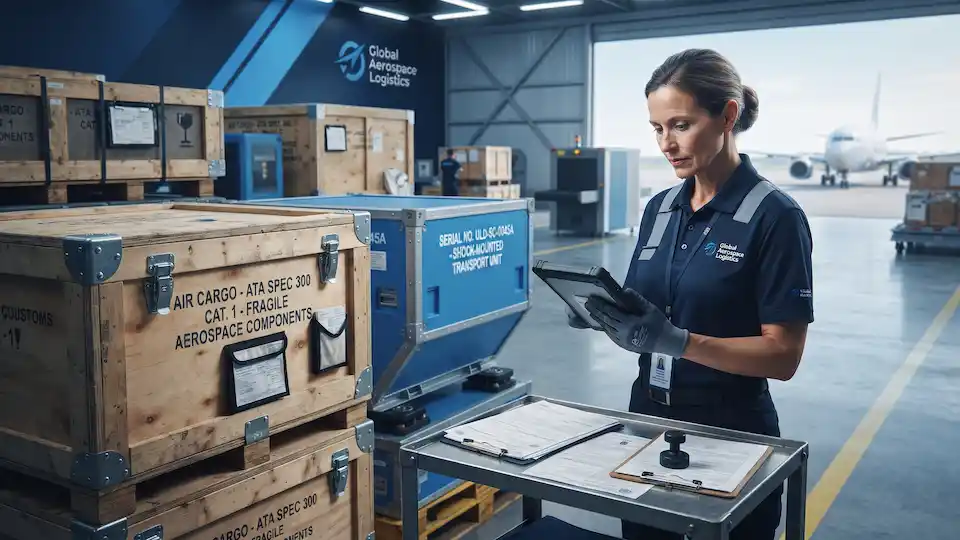
Packaging must comply with ATA Spec 300 standards to withstand rough transit, featuring moisture-barrier bags, desiccant packs for humidity control, and customized foam cradles for sensitive avionics.
Common International Logistics Mistakes
Three frequent compliance errors cause costly customs seizures. First, shipping a component classified under military ITAR rules without an approved export license because the seller assumed it was an ordinary aircraft part. Second, omitting serial numbers from commercial invoices, which prevents customs agents from matching physical parts to accompanying release certificates.
Third, failing to declare used rotable cores accurately as repairable exchanges, triggering full commercial import duties rather than temporary repair-under-warranty exemptions. Mastering these rules protects dealers building an international customer base as outlined in guides on how to become an aircraft parts dealer.
Frequently Asked Questions
Do I need a special license to export civil aircraft parts?
Most civil commercial aircraft parts classified under EAR dual-use rules do not require an individual export license for standard destination countries, provided you screen buyers against restricted party lists and declare accurate ECCN codes. However, military ITAR articles always require prior export licensing.
What is an ATA Carnet and when is it used?
An ATA Carnet is an international customs document that permits duty-free, tax-free temporary importation of professional equipment—such as portable engine borescopes, calibration test sets, or rotable loaner tools—into participating countries for up to one year without posting cash bonds.
How do I claim duty-free status on imported aircraft parts?
To claim duty-free import exemptions under civil aircraft trade agreements, your commercial invoice must cite the correct civil HTS code and include a formal written declaration certifying that the imported parts will be used exclusively in civil aircraft maintenance or manufacturing.