
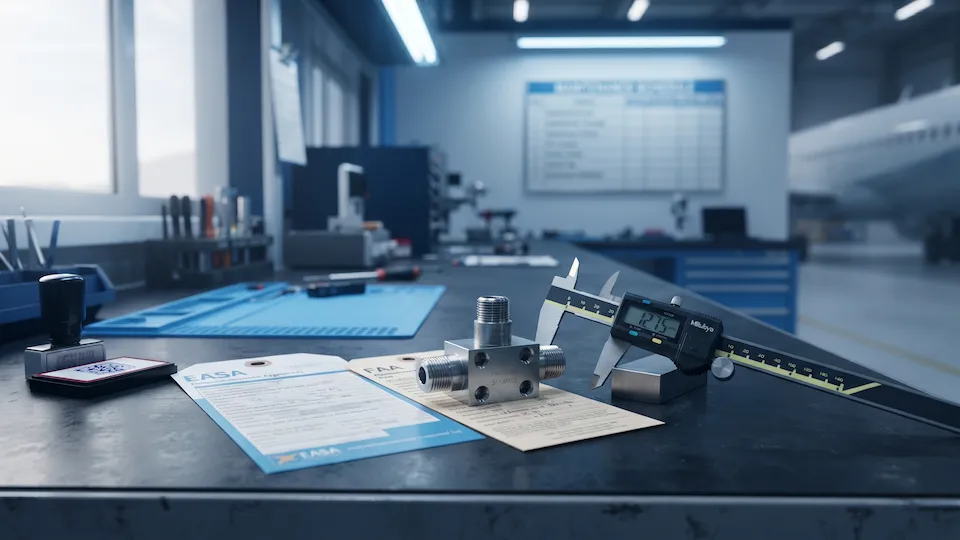
Navigating aircraft parts certification requires understanding how authorized release certificates confirm airworthiness and design conformity for aerospace components. Regulators like the FAA and EASA mandate official documents, such as FAA Form 8130-3 and EASA Form 1, accompanied by unbroken traceability records before any new or used part can be legally installed.
Without verified certification paperwork, even a brand-new jet engine part is legally considered unapproved hardware and cannot be installed on a certified aircraft. Understanding release documents, dual-release protocols, and back-to-birth documentation protects operators from costly groundings and regulatory violations.
Key Takeaways
- An authorized release certificate serves as an official legal statement of airworthiness and conformity to approved design data.
- FAA Form 8130-3 and EASA Form 1 are the primary global standards for authorized component release.
- New parts require production approval release, while overhauled or repaired parts require release by a certified Part 145 repair station.
- Life-Limited Parts (LLPs) require unbroken back-to-birth documentation tracking every flight hour and cycle since initial manufacturing.
The Anatomy of FAA Form 8130-3
FAA Form 8130-3, officially titled the "Authorized Release Certificate, Airworthiness Approval Tag," is the benchmark certification document used across the global aerospace industry. Governed by FAA Order 8130.21, the form serves two distinct regulatory functions based on which block is executed:
- Conformity Release (Block 13a): Issued by a Production Approval Holder (PAH)—such as an airframe OEM or licensed PMA manufacturer—certifying that a brand-new component conforms to approved type design data and is in a condition for safe operation.
- Return to Service (Block 14a): Issued by an authorized Part 145 repair station or certificated maintenance organization, certifying that maintenance, overhaul, or alteration work was accomplished in accordance with applicable airworthiness regulations and approved technical manuals.
Key information blocks on Form 8130-3 include the certificate tracking number (Block 3), part description and nomenclature (Block 7), part number (Block 8), eligibility (Block 9), quantity (Block 10), serial or batch number (Block 11), and status/work description (Block 12).
New vs Used Release Documents: Who Can Issue Them?
A critical distinction in aircraft parts certification lies in the difference between new production release documents and used maintenance release certificates. Sourcing agents must verify who holds the authority to issue the document for each part condition:
| Part Condition | Authorized Release Document | Authorized Issuer | Key Verification Required |
|---|---|---|---|
| Factory New (FN / NE) | FAA Form 8130-3 (Block 13a) / EASA Form 1 | Production Approval Holder (PAH / OEM / PMA) | Conformity to type design; batch/lot traceability |
| Overhauled (OH) | FAA Form 8130-3 (Block 14a) / Dual Release | Certified Part 145 Repair Station | Disassembly, NDT inspection, work order detail |
| Repaired / Inspected (RP/SV) | FAA Form 8130-3 (Block 14a) / EASA Form 1 | Part 145 MRO / Authorized Certifying Staff | Targeted repair manual reference; functional test |
| Life-Limited Part (LLP) | Form 8130-3 + Full Life Trace Package | PAH or Overhaul Station + Airline Records | Continuous flight hours and cycle logs since new |
Parts distributors and brokers do not hold regulatory authority to issue Form 8130-3 tags unless they operate a certified repair station. Distributors instead provide an ATA Spec 106 certificate of conformance, transmitting the original manufacturer or repair station tag along with the chain of custody.
EASA Form 1 and Dual-Release Protocols Under BASA
European aerospace components are released using EASA Form 1, which mirrors the structure and intent of the FAA form. Through the Bilateral Aviation Safety Agreement (BASA) between the United States and the European Union, the FAA and EASA recognize each other's maintenance release systems through Maintenance Annex Guidance (MAG).
To achieve maximum commercial liquidity, aerospace facilities frequently issue a Dual-Release Form 8130-3 / EASA Form 1. For a US Part 145 repair station to issue a dual release, it must hold EASA Part-145 approval under the BASA agreement and include specific regulatory statements in Block 12, certifying compliance with both 14 CFR Part 43 and EASA Part-145. Dual-release components can be installed interchangeably on US-registered (N-registered) or European-registered aircraft without secondary certification.
Back-to-Birth Traceability for Life-Limited Parts (LLPs)
For standard non-critical components, traceability back to an approved source (such as the last operating airline or certificated repair station) is generally sufficient. However, for Life-Limited Parts (LLPs)—including jet engine turbine disks, compressor spools, landing gear main cylinders, and propeller hubs—regulators enforce mandatory Back-to-Birth (BtB) traceability.
An LLP trace package must document every operating hour and flight cycle accumulated across the component's entire operational life, including:
- The original manufacturer's release tag showing initial date of entry into service.
- Chronological removal and installation records from every airframe or engine on which the component operated.
- Non-incident/non-accident statements (NIS) from every previous operating carrier.
- Maintenance release records for every workshop visit or intermediate repair.
- Verification of compliance with mandatory airworthiness directives vs service bulletins.
A missing logbook entry or unverified operating interval can permanently render an LLP unairworthy, destroying tens or hundreds of thousands of dollars in commercial asset value. Review our complete guide to airworthiness certificates explained for broader airframe certification contexts.
Frequently Asked Questions
What is an FAA Form 8130-3 used for?
FAA Form 8130-3 certifies that a new aerospace component conforms to approved design standards or that a maintained component has been approved for return to service.
Can a parts distributor issue an FAA Form 8130-3?
No. Only certified Production Approval Holders or certified Part 145 repair stations can issue Form 8130-3. Distributors provide an ATA Spec 106 certificate transmitting the original tag.
What is a dual-release FAA and EASA tag?
A dual-release tag certifies compliance with both FAA and EASA airworthiness regulations, allowing the component to be installed interchangeably on US and European registered aircraft.
What documents are required for life-limited aircraft parts?
Life-limited parts require full back-to-birth documentation, including birth records, total hours/cycles, complete airline removal records, and non-incident statements.